The Engine of Insight: Deconstructing the Modern Data Catalog Market Platform

Architectural Foundations of a Modern Platform
At the heart of the thriving data catalog market lies the platform itself—a sophisticated assembly of technologies designed to index, understand, and democratize an organization's data assets. A modern Data Catalog Market Platform is fundamentally a metadata management system, but its architecture goes far beyond a simple repository. The core architectural component is a flexible and scalable metadata graph. This graph model is crucial as it allows the platform to represent the complex, interconnected relationships between data assets, business terms, users, and analytical artifacts in a way that a traditional relational database cannot. Ingesting metadata into this graph is the next key architectural layer, which involves a system of connectors. These connectors are designed to scan a vast and diverse array of sources—from relational databases like PostgreSQL and Oracle, to cloud data warehouses like Snowflake and BigQuery, BI tools like Tableau and Power BI, and even ETL pipelines. The platform must be able to extract not just technical metadata (schemas, data types) but also operational (usage logs, query history) and social metadata (user ratings, comments). This multi-faceted ingestion process feeds the central graph, creating a rich, context-aware representation of the entire data ecosystem, forming the bedrock upon which all other platform features are built.
Key Features That Drive User Value
The value of a data catalog platform is realized through its feature set, which is designed to serve a spectrum of users from technical to business. Intelligent search is the most fundamental feature, acting as a "Google for enterprise data." It allows users to find data assets using natural language, business terms, or technical queries, with results ranked by relevance, popularity, and official certifications. Data lineage is another killer feature, providing a visual, end-to-end map of data flow. This allows an analyst to see where a dashboard's data originated, what transformations it underwent, and who else is using it, which is indispensable for building trust and debugging issues. A collaborative business glossary bridges the communication gap between IT and business by linking cryptic table and column names to familiar business terminology, definitions, and policies. Collaboration features, such as wikis, comments, and Q&A forums embedded on each data asset's page, foster a community of knowledge-sharing, allowing users to ask questions and get answers in the context of the data itself. Finally, integrated governance capabilities enable data stewards to apply policies, manage access controls, and certify datasets directly within the platform, making governance an active, living process rather than a static document.
Deployment Models: Cloud, On-Premise, and Hybrid
Data catalog platforms are offered in several deployment models to meet the diverse security, scalability, and operational needs of different organizations. The traditional on-premise deployment involves installing and managing the data catalog software on the company's own servers. This model is often preferred by organizations in highly regulated industries like government and finance, as it provides maximum control over data and security. However, it requires significant upfront investment in hardware and ongoing maintenance effort from an internal IT team. The cloud-native or SaaS (Software-as-a-Service) model has become increasingly popular due to its numerous advantages. In this model, the vendor hosts and manages the platform, and customers access it via a web browser on a subscription basis. This approach offers lower upfront costs, rapid deployment, automatic updates, and elastic scalability. The third and increasingly common option is the hybrid model. This model allows an organization to deploy the data catalog's metadata repository in their own private cloud or on-premise environment for security, while the application's user interface and processing plane can be run in the public cloud. This approach offers a balance between the security and control of on-premise with the scalability and ease of use of the cloud, making it a compelling choice for many large enterprises navigating a mixed-infrastructure reality.
The Role of AI and Machine Learning in the Platform
The future of the data catalog platform is inextricably linked with the integration of artificial intelligence (AI) and machine learning (ML). These technologies are transforming catalogs from passive, descriptive tools into active, intelligent systems that automate and augment data management. One of the primary applications of AI is in automated data classification and tagging. ML algorithms can scan data content and automatically identify and tag sensitive information like PII (names, social security numbers) or classify columns based on their content (e.g., identifying a column as "revenue" or "customer ID"), a task that would be impossibly time-consuming to do manually at scale. AI also powers intelligent recommendations, where the platform can suggest relevant datasets to an analyst based on their role, their query history, and what similar users have found valuable. This "Netflix for data" experience significantly accelerates data discovery. Furthermore, ML is used to detect anomalies in data quality and pipeline operations, proactively alerting data teams to potential issues before they impact downstream analytics. By automating curation, enhancing discovery, and proactively managing data health, AI and ML are not just adding features—they are fundamentally elevating the strategic value of the data catalog platform, making it an indispensable intelligent hub for the data-driven enterprise.
➤ Latest Market Intelligence from Market Research Future:
Digital Evidence Management Market
Категории
Больше
Columbina’s Team Strategies Columbina, a Hydro catalyst wielder in Genshin Impact, excels at triggering and enhancing reactions like Lunar-Charged, Lunar Bloom, and Lunar Crystallize. This versatility makes her adaptable to a wide range of team compositions. Experimenting with various characters alongside her can uncover powerful synergies and maximize her potential. In this guide,...

An Industry in Constant Motion The online food delivery market is a crucible of innovation, where new ideas and business models emerge at a dizzying pace. To stay relevant and competitive, companies must not only keep up with but also anticipate and drive the next wave of change. The most influential Online Food Delivery Market Trends are reshaping everything from food preparation and logistics...

According to the latest report published by Data Bridge Market Research, the Heart Valve Devices Market Data Bridge Market Research analyzes that the heart valve devices market is expected to reach the value of USD 23,665.51 million by 2030, at a CAGR of 13.4% during the forecast period. Heart Valve Devices Market report offers a thorough overview of product specification,...
Regional analysis plays a pivotal role in comprehending the complexities of the Legal Research and Document Review Services market. By 2035, the market is poised to reach an impressive size of 20.5 billion USD, growing at a CAGR of 6.27%. This growth is not uniform; rather, it varies significantly across different geographical areas, reflecting local legal needs, regulatory environments, and...
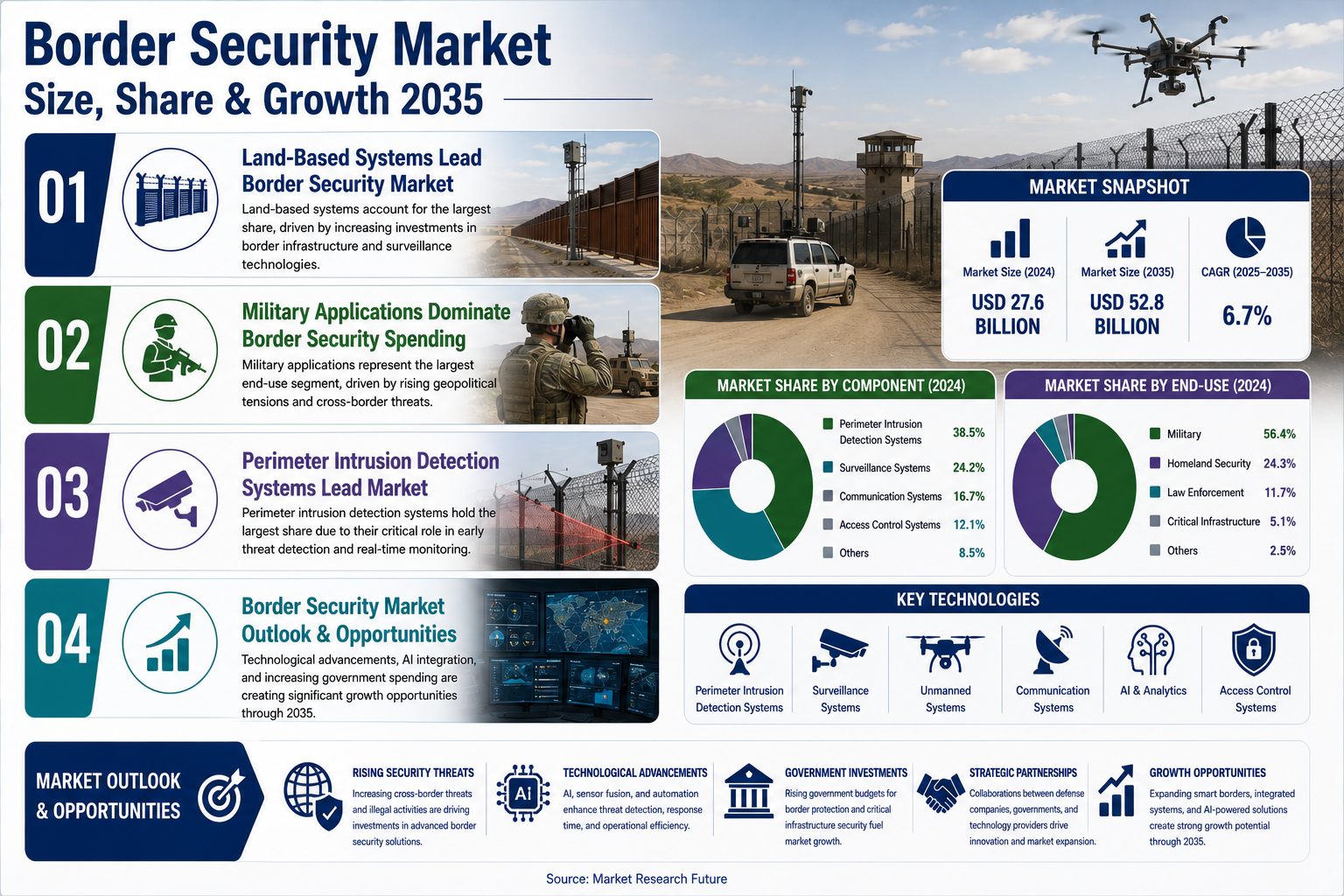
Land-based systems are currently the dominant platform segment in the Border Security market, holding the largest share due to the majority of global frontiers being terrestrial and requiring extensive infrastructure. As per Market Research Future analysis, land-based systems anchored the Border Security Market with a 54.1% share in 2025, reflecting heavy investment in integrated perimeter...