Cloud Storage Gateway Industry Bridging On-Premises and Cloud
The Cloud Storage Gateway industry is experiencing a transformative phase as enterprises worldwide seek to bridge their legacy on-premises file systems with scalable, cost-effective object storage in the cloud. Cloud Storage Gateway Market stood at USD 8.28 billion in 2025 and opens the forecast window at USD 10.09 billion in 2026, climbing to USD 59.64 billion by 2035 at a 21.8% CAGR. Two catalysts anchor that trajectory. The European Data Act, in force since January 2024, forces cloud providers to strip switching charges by 2027, which pushes buyers toward portable gateway layers rather than proprietary storage silos. Parallel to that, hyperscale capital expenditure crossed USD 200 billion in 2024, expanding the object-storage capacity these appliances front-end.
The transformation of the Cloud Storage Gateway industry is being driven by the retirement of tape libraries, aging scale-up filers, and branch-office file servers. Replacing them are caching appliances and virtual gateways that present familiar SMB, NFS, and iSCSI targets while writing durably to object tiers behind the scenes. A recent source projects global data creation reaching 291 zettabytes by 2027, and roughly 60% of that payload is unstructured file data that legacy arrays cannot economically hold. Hybrid-cloud migration mandates are driving approximately 4.8% of the CAGR, as big businesses plan to move about 60% of their IT infrastructure to the cloud by 2025. Unstructured data volume growth contributes 4.1%, while ransomware resilience and immutable snapshots contribute 3.4%, with cyber-insurance underwriters increasingly discounting premiums by 8-12% where write-once retention is demonstrable.
The competitive landscape of the Cloud Storage Gateway industry features a mix of hyperscale platform vendors and independent specialists. Key players include Amazon Web Services, Microsoft, NetApp, Google Cloud, Nasuni, CTERA Networks, Panzura, Hitachi Vantara, Dell Technologies, IBM, Oracle, and Zadara. The estimated HHI sits near 1,150, with the top five suppliers holding roughly 52-58% of revenue. Amazon Web Services leads with approximately 17-21% share, Microsoft follows with 13-16%, NetApp holds 8-11%, Google Cloud holds 6-9%, and Nasuni holds 5-8%. Recent developments include AWS introducing S3 Express One Zone in November 2023, Microsoft's Azure Storage Mover reaching general availability, and Nasuni securing a growth investment from Vista Equity Partners valuing the company above USD 1.2 billion.
Looking ahead, the Cloud Storage Gateway industry faces both opportunities and challenges as it continues to evolve. Sovereign cloud intermediation presents significant opportunities, with governments in the Gulf and Southeast Asia building national clouds while keeping hyperscale partnerships for non-regulated workloads. Emerging-market SME adoption is creating opportunities, with millions of mid-sized enterprises running on unsupported on-premises file servers. Data monetization services are converting a hardware business into recurring analytics revenue, with early adopters reporting attach rates near 30%. However, the industry must address challenges related to egress charges, WAN bandwidth and latency ceilings, and shared-responsibility security ambiguity. As the industry continues to mature, the ability to deliver autonomous, policy-driven, and sovereign-compliant gateway solutions will be the key differentiator.
FAQs:
Q1: What is driving the growth of the Cloud Storage Gateway Market?
Key drivers include hybrid-cloud migration mandates, unstructured data volume growth, ransomware resilience requirements, data sovereignty regulations, AI/ML training data pipeline caching, and legacy filer refresh cycles.
Q2: Who are the key players in the Cloud Storage Gateway Market?
Major players include Amazon Web Services, Microsoft, NetApp, Google Cloud, Nasuni, CTERA Networks, Panzura, Hitachi Vantara, Dell Technologies, IBM, Oracle, and Zadara.
➤ In-Depth Market Studies by Market Research Future:
Categorias
Leia Mais
Riccioli Island Treasure Hunt Unlike typical regions, Riccioli Island offers a unique aquatic expanse that simplifies navigation, particularly with Rachel's assistance During the 'Old Man and the Whale' event, seven elusive fish await discovery Their locations are not explicitly marked, encouraging personal exploration across the island's waters Successfully catching the Draco Cobia,...

Dengue Treatment Market According to the latest report published by Data Bridge Market Research, the Europe Dengue Treatment Market Dengue Treatment Market size was valued at USD 33.64 Million in 2024 and is expected to reach USD 170.60 Million by 2032, at a CAGR of 22.50% during the forecast period The market growth is largely fueled by the rising...

Middle East and Africa Dark Fiber Networks Market According to the latest report published by Data Bridge Market Research, the Middle East and Africa Dark Fiber Networks Market The Middle East and Africa Dark Fiber Networks Market size was valued at USD 456.11 million in 2025 and is expected to reach USD 996.84 million by 2033, at a CAGR of 10.3% during...
Comprehensive Data Governance Platform Market Analysis The Comprehensive Data Governance Platform Market Analysis highlights the increasing importance of structured data management as organizations expand digital operations. Enterprise information is distributed across applications, cloud infrastructure, databases, analytics systems, and connected devices, creating challenges involving...

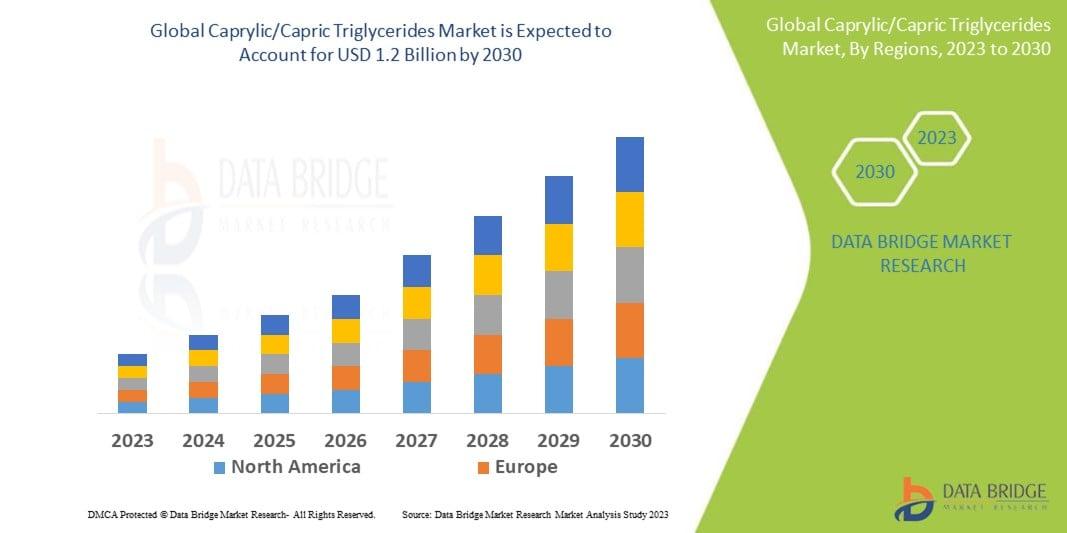
According to the latest report published by Data Bridge Market Research, the Caprylic/Capric Triglycerides Market The caprylic/capric triglycerides market which is USD 0.73 billion in 2022, is expected to reach USD 1.2 billion by 2030, at a CAGR of 6% during the forecast period 2023 to 2030. In addition to the insights on market scenarios such as market value, growth rate,...