Rising Demand For High Density Wireless Infrastructure In Smart Venues And Education

Modern public gathering spaces, large-scale entertainment arenas, international transportation hubs, and higher education campuses represent some of the most demanding wireless networking environments in the world. In the rapidly modernizing WLAN Market, the urgent requirement to deliver high-capacity, uninterrupted connectivity across high-density client environments is driving massive investments in specialized wireless infrastructure. In venues such as eighty-thousand-seat sports stadiums, sprawling convention centers, and major international airport terminals, tens of thousands of concurrent users congregate in compact physical footprints, all demanding instantaneous access to high-bandwidth digital services. Spectators expect to stream live high-definition video replays, upload social media content, utilize mobile ticketing systems, and execute contactless concessions payments seamlessly. Similarly, modern higher education universities have embraced digital learning models where lecture halls filled with hundreds of students require concurrent, high-throughput wireless access to cloud-hosted academic platforms, real-time collaboration tools, and interactive digital testing environments. Supporting these immense concurrency levels without suffering severe network collapse requires highly specialized radio frequency engineering, robust access point hardware, and intelligent airtime management architectures.
Engineering high-performance wireless local area networks for high-density public venues requires a fundamental departure from traditional coverage-oriented network design in favor of highly disciplined capacity-oriented micro-cell architectures. In standard enterprise office deployments, access points are positioned with omnidirectional antennas to broadcast wide coverage footprints. In contrast, high-density stadium and auditorium designs utilize dense arrays of specialized access points equipped with narrow-beam directional smart antennas, strategically mounted beneath arena seats, on overhead catwalks, or along handrails. These directional antennas precisely focus radio frequency energy onto small, discrete seating clusters, creating thousands of tiny micro-cells while strictly limiting co-channel interference between adjacent access points. By utilizing narrow-beam spatial containment alongside the expansive, clean radio spectrum provided by Wi-Fi 6E and Wi-Fi 7 in the six gigahertz band, network architects can reuse frequency channels extensively across the physical facility. This micro-cell design dramatically multiplies aggregated system capacity, enabling thousands of client devices to transmit and receive data simultaneously without overwhelming available airtime or causing destructive packet collisions.
Beyond providing basic internet connectivity, modern high-density wireless local area networks serve as powerful digital platforms that unlock rich interactive services, operational efficiencies, and new commercial revenue streams for venue operators. Integrated Bluetooth Low Energy (BLE) and ultra-wideband location beacons embedded within modern access points enable highly precise indoor location-based services across vast public venues. Stadium and airport apps can leverage this spatial data to deliver turn-by-turn indoor wayfinding navigation, directing travelers to departure gates or guiding sports fans to their exact seats and shortest concession lines. Furthermore, venue operators capture granular, anonymized foot-traffic analytics, gaining deep strategic insights into visitor flow patterns, dwell times, and physical bottleneck locations, allowing for optimized staffing allocation and dynamic commercial concession pricing. In higher education environments, location-aware wireless networks automate student attendance tracking in large lecture halls, enable campus-wide emergency broadcasting notifications to exact building coordinates, and provide faculty with real-time feedback on digital student engagement during interactive instructional sessions.
In conclusion, deploying robust, high-density wireless local area network infrastructure has become an indispensable requirement for modern public venues, higher education institutions, and municipal facilities aiming to deliver world-class visitor experiences. Outdated, under-provisioned wireless networks that suffer from frequent disconnects, sluggish throughput, and high packet latency frustrate visitors, tarnish institutional reputations, and directly undermine commercial revenue opportunities. By investing in next-generation high-density WLAN platforms equipped with directional smart beamforming antennas, automated client load balancing, and advanced Wi-Fi 6E/7 capabilities, venue operators ensure seamless, high-speed connectivity for tens of thousands of simultaneous users. These advanced networks provide the reliable foundation required to support emerging interactive technologies, such as frictionless cashless checkout stores, augmented reality game-day fan experiences, and fully digital hybrid university classrooms. Organizations that proactively modernize their high-density wireless infrastructure will achieve superior customer engagement, maximize venue operational efficiency, and capture lucrative digital monetization opportunities across the modern connected landscape.
Kategorien
Mehr lesen
The Learning Management System (LMS) Market analysis is demonstrating remarkable momentum as educational institutions and enterprises continue investing in intelligent digital learning platforms. Learning Management System (LMS) Market Size was estimated at USD 18.9 Billion in 2024. The LMS industry is projected to grow from USD 21.66 Billion in 2025 to USD 84.79 Billion by 2035,...

Adaptive Lighting System Market is becoming an important part of the transition toward intelligent and responsive lighting environments. Modern buildings, transportation infrastructure, commercial facilities, and residential spaces are increasingly adopting lighting solutions that can respond to changing conditions. Adaptive systems can adjust illumination according to factors such as...

The Secure Access Service Edge Market Growth is experiencing significant expansion as organizations worldwide adopt advanced cloud-based security frameworks to protect distributed digital environments. The increasing adoption of remote work models, cloud applications, edge computing, and hybrid IT infrastructures has transformed traditional network security requirements, creating strong...
A privacy-oriented email service, Proton Mail, provided payment information about a subscriber to Swiss law enforcement, which subsequently reached the FBI. Court documents obtained by 404 Media reveal that this data assisted federal agents in tracing the person allegedly managing an anonymous email address connected to Atlanta's "Stop Cop City" activism. The Stop Cop City campaign arose after...
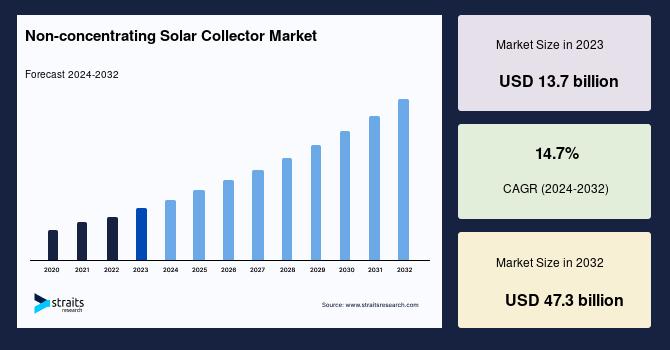
Non-concentrating Solar Collector Market Overview A new report titled “Global Non-concentrating Solar Collector Market Professional Report 2025-2033” has been added by Straits Research to its repository of research reports. The report analyzes and estimates the market on a global, regional, and country level. The report offers data from previous years along with an in-depth analysis...