Categorizing the Diverse and Expansive Software as a Service Market Types

The global SaaS market is not a single, uniform entity but rather a broad and varied landscape that can be segmented in several meaningful ways. Understanding the different Software As A Service Market Types is essential to grasping the full scope and structure of the industry. The most common method of categorization is by the specific business function or application the software serves. This application-based segmentation includes major categories like Customer Relationship Management (CRM), dominated by players like Salesforce, which helps businesses manage their interactions with current and potential customers. Another huge category is Enterprise Resource Planning (ERP), with cloud-based solutions from companies like SAP, Oracle NetSuite, and Microsoft Dynamics 365, which integrate core business processes such as finance, HR, manufacturing, and supply chain. Other prominent application types include Collaboration software (e.g., Slack, Microsoft Teams, Zoom), Human Capital Management (HCM) software (e.g., Workday, SuccessFactors), and Business Intelligence (BI) and analytics platforms, each forming a substantial market in its own right.
Another crucial way to classify the market is by the target audience, which primarily divides SaaS into horizontal and vertical types. Horizontal SaaS refers to software that is designed for a wide audience across many different industries. These applications address common business needs that are not specific to any one sector. Prime examples include email and office productivity suites like Google Workspace and Microsoft 365, accounting software like QuickBooks Online, or project management tools like Asana. The key advantage of horizontal SaaS is its massive potential market size. In contrast, vertical SaaS is software that is built and tailored for the unique needs of a single, specific industry. For example, Veeva Systems provides cloud-based software exclusively for the pharmaceutical and life sciences industry, while Toast offers a complete platform for restaurant management. While the total addressable market for any single vertical SaaS product is smaller, these solutions offer deep, specialized functionality that horizontal players cannot match, leading to stronger customer loyalty and often higher revenue per customer.
The market can also be segmented by the deployment model and the type of customer served. In terms of deployment, while the vast majority of SaaS is delivered via a public cloud (a multi-tenant environment where multiple customers share the same infrastructure), some organizations, particularly those in highly regulated industries or with stringent security requirements, opt for private cloud SaaS. In a private cloud model, the software and infrastructure are dedicated to a single customer. A hybrid model, which combines elements of both, is also common. In terms of customer type, the market is broadly split into Business-to-Business (B2B) and Business-to-Consumer (B2C) SaaS. B2B SaaS, which constitutes the larger portion of the market, involves vendors selling software subscriptions to other companies. B2C SaaS involves vendors selling directly to individual consumers, with popular examples including streaming services like Netflix and Spotify, and cloud storage services like Dropbox and iCloud.
Finally, a more technical but increasingly important classification is based on the architectural design, particularly the distinction between monolithic applications and microservices-based applications. Traditional, monolithic SaaS applications are built as a single, unified unit. While simpler to develop initially, they can become difficult to update and scale over time. The modern approach, favored by many new and forward-thinking SaaS companies, is to use a microservices architecture. In this model, the application is broken down into a collection of smaller, independently deployable services. Each service is responsible for a specific business capability and can be developed, deployed, and scaled independently of the others. This architectural type offers greater flexibility, scalability, and resilience, allowing vendors to innovate more quickly and maintain large, complex applications more easily. Understanding these different market types provides a clear framework for analyzing the competitive dynamics, growth opportunities, and strategic imperatives within the vast and multifaceted SaaS universe.
Top Trending Reports:
Categorias
Leia Mais
Adult malignant glioma remains one of the most aggressive and difficult-to-treat forms of brain cancer, creating significant challenges for healthcare providers and researchers worldwide. Continuous advancements in oncology research, precision medicine, targeted therapies, and immunotherapy are reshaping treatment strategies, offering renewed hope for improved patient outcomes. Growing...

The Biological Indicators Market is also supported by improvements in indicator design and microbial technology. Manufacturers are working to improve reliability, sensitivity, shelf life, and ease of interpretation across different sterilization processes. The Biological Indicators Market was valued at US$ 431.15 Million in 2025 and is expected to reach US$ 697.31 Million by 2034, registering a...
The Gluten Free Pasta Market is gaining momentum as consumers increasingly seek food products that accommodate dietary restrictions and evolving eating preferences. Gluten-free pasta is manufactured using ingredients such as rice, corn, quinoa, chickpeas, lentils, and other gluten-free grains and legumes. These alternatives provide manufacturers with opportunities to develop products that...

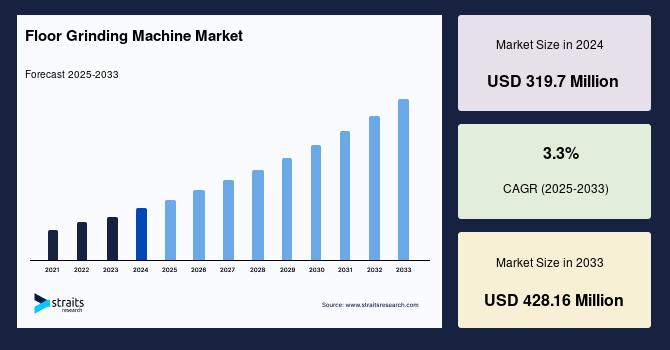
Floor Grinding Machine Industry Outlook: Straits Research has introduced a detailed analytical study on the Floor Grinding Machine Market, offering insights into market valuation, segmentation framework, and long-term growth trajectory. The publication delivers a structured overview of market drivers, constraints, technological advancements, and strategic developments shaping the industry....
According to the latest report published by Data Bridge Market Research, the Underwater Concrete Market Data Bridge Market Research analyses that the underwater concrete market was valued at USD 203.39 billion in 2021 and is expected to reach USD 365.45 billion by 2029, registering a CAGR of 7.60% during the forecast period of 2022 to 2029. Underwater Concrete Market is the...