Distributed Energy Resources (DER): The Building Blocks of a Resilient and Sustainable Energy Grid
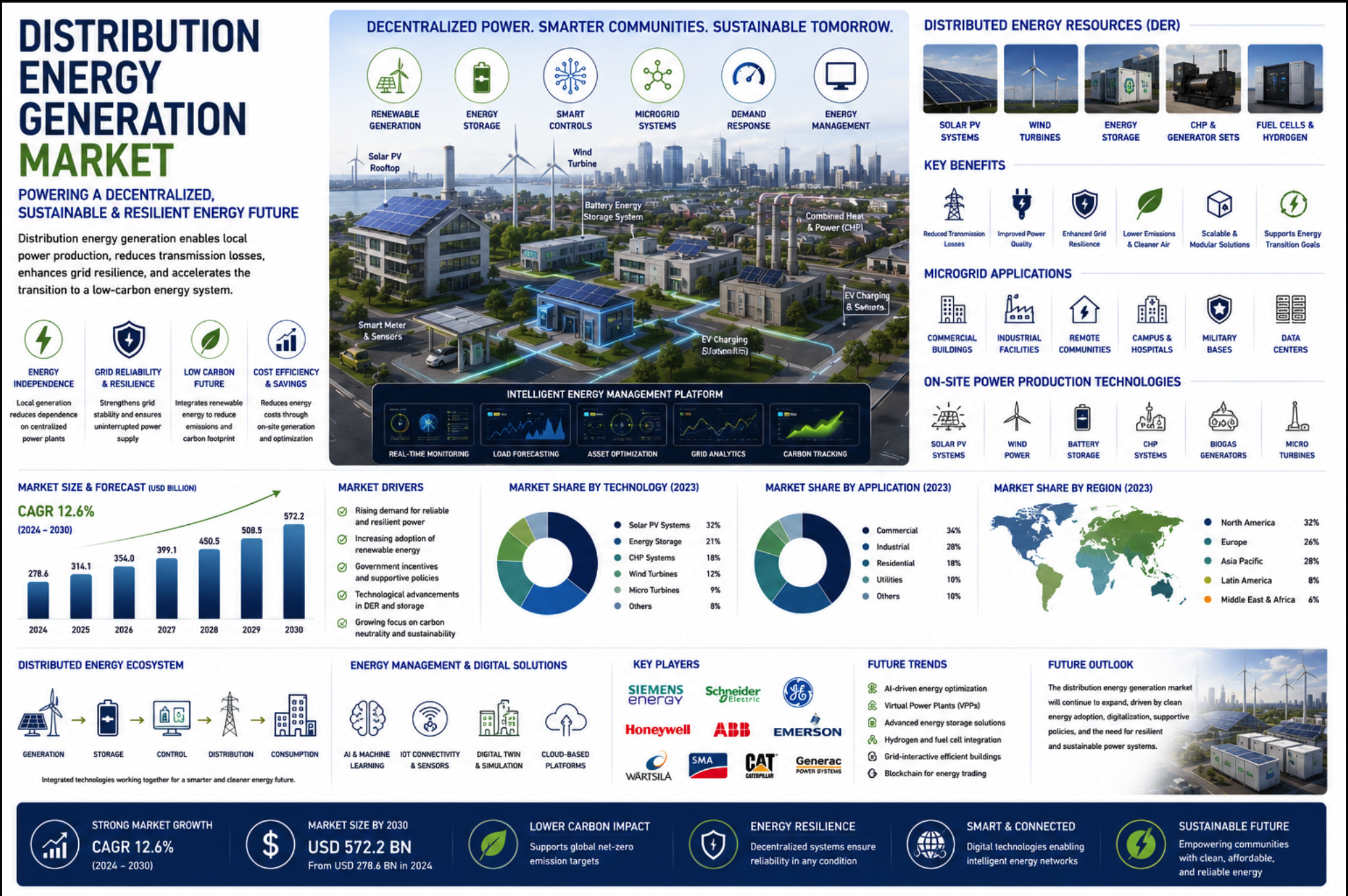
An in-depth examination of distributed energy resources (DER), covering their types, integration into the grid, and their role in building a resilient and sustainable energy system.
Distributed Energy Resources (DER) are the individual building blocks of a resilient and sustainable energy grid, encompassing a wide array of small-scale power generation and storage technologies that are located close to the point of use. These resources include solar photovoltaic (PV) systems, wind turbines, battery storage, fuel cells, and combined heat and power (CHP) units, which can be aggregated and managed to provide grid services, enhance resilience, and reduce carbon emissions. The global market for these resources is a foundational element of the broader Distribution Energy Generation Market, valued at $281.7 billion in 2024 and projected to reach $693.3 billion by 2035. The photovoltaic (PV) technology segment currently holds the largest market share due to its widespread adoption and efficiency in harnessing solar energy, but wind turbine technology is emerging rapidly as the fastest-growing segment.
Distributed energy resources are critical for enabling the transition to a more flexible, efficient, and low-carbon energy system. By generating power close to where it is consumed, DER reduce transmission losses, alleviate strain on the grid, and provide backup power during outages. The growing demand for Distributed Energy Resources (DER) is a direct response to the need for greater energy resilience, the integration of renewable energy, and the empowerment of consumers to become active participants in the energy market. The on-grid deployment model currently holds the largest market share, integrating DER with the existing power system, but the microgrid segment is emerging, allowing for localized energy independence and enhanced resilience.
The adoption of DER is being driven by several factors, including technological advancements, supportive regulatory frameworks, and the increasing economic competitiveness of renewable energy. The cost of solar panels and batteries has fallen dramatically, making DER more accessible to a wider range of consumers. Policies such as net metering, feed-in tariffs, and tax credits are creating a favorable economic environment for DER investment. The increasing frequency of extreme weather events is also highlighting the value of DER for providing backup power and grid resilience. The residential application segment remains a significant driver, but the commercial and industrial sectors are rapidly expanding their use of DER to manage energy costs and improve sustainability. The integration of AI and machine learning is optimizing energy production and consumption.
The market for DER is characterized by a dynamic ecosystem of technology providers, project developers, and aggregators. Key players are developing innovative solutions to integrate and manage DER effectively. In September 2025, EDF launched a new initiative focused on hydrogen production from renewable sources. In Q3 2024, Sonnen partnered with E.ON to launch Germany's largest residential virtual power plant. As the industry continues to evolve, the importance of microgrid energy solutions will drive further advancement in distributed energy resources, ensuring these essential building blocks can support a resilient and sustainable energy future.
الأقسام
إقرأ المزيد
The Helicobacter Pylori Infection Treatment Market is undergoing a fundamental transformation, evolving from standardized antibiotic regimens into personalized therapeutic approaches that address the growing challenge of antibiotic resistance while improving eradication rates. As of 2025, the market was valued at approximately 2.15 billion USD and is projected to reach 3.2 billion USD by...

Sand Control Services Market According to the latest report published by Data Bridge Market Research, the Sand Control Services Market sand control services Market size was valued at USD 1.86 billion in 2024 and is projected to reach USD 2.79 billion by 2032, with a CAGR of 5.20% during the forecast period of 2025 to 2032. Sand control...

The dynamics of Defense IT Spending Market Growth are being reshaped by a powerful wave of technological advancements that are redefining traditional business models. The current trajectory is heavily influenced by the global shift towards digital transformation, where automation and intelligent workflows are becoming standard practice. This evolution is creating a fertile environment for...
Hollow Knight: Silksong: The Underworks Guide to Not Getting Steam-Cooked As of 2026, the Underworks remains one of Hollow Knight: Silksong's most charmingly hostile detours. After the Last Judge finally stops being a nightmare and the Grand Gate swings open, the game whispers sweet promises about the Citadel. Then the elevator coughs, dies, and drops the player into a dark industrial basement....
With its 1.0 release on July 25, 2024, 7 Days To Die presents five attributes—Perception, Agility, Fortitude, Strength, and Intelligence—each governing related perks and weapon damage. You start with four skill points and gain one per level, and respec is expensive, so early specialization matters. Here’s a concise ranking based on overall utility, updated to reflect the...