The Business Operating System: An Introduction to the ERP Software Industry

Defining the Central Nervous System of the Enterprise
In the complex world of modern business, organizations are composed of numerous distinct functions—finance, human resources, manufacturing, supply chain, and sales—all of which need to work in concert. The technology that makes this possible is the focus of the vast and critically important Erp Software industry. Enterprise Resource Planning (ERP) software is a suite of integrated applications that an organization uses to collect, store, manage, and interpret data from its many business activities. An ERP system acts as the central nervous system and single source of truth for the entire enterprise. Instead of having separate, siloed software for accounting, another for inventory, and a third for HR, an ERP system combines these processes into a single, unified platform with a shared database. This integration allows for the seamless flow of information between different departments, providing managers with a real-time, holistic view of their business operations. From processing an order and managing inventory to paying employees and closing the financial books, the ERP system is the foundational software that orchestrates the core functions of nearly every medium and large-sized business in the world.
The Evolution from MRP to the Intelligent Cloud ERP
The roots of ERP software can be traced back to the manufacturing sector in the 1960s with the development of Material Requirements Planning (MRP) systems, which were designed to manage inventory and production schedules. In the following decades, these systems evolved to include more business functions, becoming MRP II (Manufacturing Resource Planning), and eventually, in the 1990s, they expanded to cover finance, human resources, and other corporate functions, earning the name Enterprise Resource Planning. These early, "monolithic" ERP systems were massive, on-premise installations that were incredibly complex, expensive, and took years to implement. The next major evolution was the shift to the cloud. Modern ERP systems are now predominantly delivered as Software-as-a-Service (SaaS). Cloud ERP offers lower upfront costs, faster implementation times, greater accessibility, and automatic updates. The most recent evolution is the infusion of intelligent technologies. Today's leading ERP systems are embedded with artificial intelligence (AI), machine learning (ML), and advanced analytics, transforming them from simple systems of record into intelligent platforms that can provide predictive insights, automate complex processes, and help businesses make smarter, data-driven decisions.
Core Modules: The Building Blocks of an ERP System
An ERP system is not a single piece of software but a suite of different modules, each designed to support a specific business function. While the exact modules offered can vary, most comprehensive ERP systems include a standard set of core components. The Financial Management module is the heart of the system, handling functions like the general ledger, accounts payable, accounts receivable, and financial reporting. The Human Capital Management (HCM) or HR module manages all employee-related processes, including payroll, benefits administration, recruiting, and performance management. The Supply Chain Management (SCM) module is critical for companies that deal with physical goods, covering processes like procurement, inventory management, warehousing, and logistics. For manufacturing companies, a Manufacturing module is essential, managing production planning, shop floor control, and quality management. A Customer Relationship Management (CRM) module, while sometimes a separate system, is often included to manage sales, marketing, and customer service activities. The true power of the ERP lies in the seamless integration of these modules, allowing, for example, a sales order entered in the CRM to automatically trigger an inventory check in the SCM module and an invoice in the finance module.
The Unquestionable Business Value of ERP Integration
The primary reason why companies invest millions of dollars and countless hours into implementing ERP systems is the immense business value they provide. The most significant benefit is improved operational efficiency. By automating and streamlining core business processes and eliminating redundant manual data entry, ERP systems can drastically reduce administrative overhead and free up employees to focus on more value-added activities. The second major benefit is enhanced visibility and decision-making. By providing a single, unified source of data, an ERP system gives managers a real-time, 360-degree view of their business. This allows them to make faster, more informed decisions based on accurate data rather than on siloed spreadsheets and guesswork. Better compliance and risk management is another key value proposition. ERP systems provide robust financial controls and detailed audit trails, making it easier for companies to comply with financial regulations like Sarbanes-Oxley (SOX) and other industry-specific mandates. Finally, a modern, agile ERP system can provide a platform for business innovation, enabling companies to quickly launch new products, expand into new markets, and adapt to changing business models.
Explore More Like This in Our Reports:
الأقسام
إقرأ المزيد
The Industrial Boiler Market is witnessing steady growth as industries increasingly require reliable steam and heat generation for manufacturing, processing, and energy-intensive operations. Modern industrial boilers are being developed with improved efficiency, automation, and emission-control capabilities to support evolving industrial requirements. The Industrial Boiler Market size is...

The North America Absorbent Dressing Market is expanding steadily, supported by advanced healthcare infrastructure, increasing incidence of diabetic foot ulcers and pressure injuries, and greater adoption of modern wound care technologies. Hospitals, specialty clinics, and home healthcare providers are increasingly utilizing advanced absorbent dressings to improve wound management and patient...
The US Financial Analytics Market analysis reveals a complex and multifaceted industry with distinct segmentation patterns across applications, deployment types, end-users, components, and analytics types. The US Financial Analytics Market Analysis provides valuable insights into these segments, helping stakeholders understand market dynamics and identify growth opportunities....
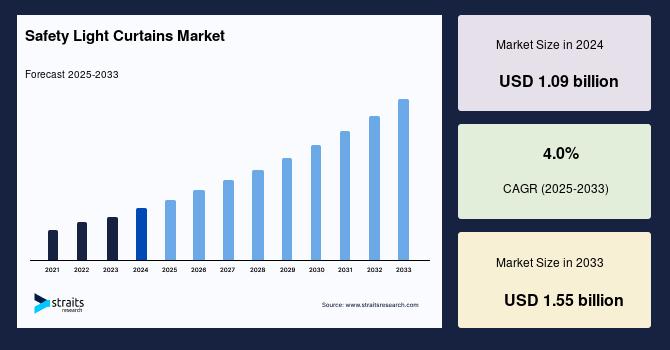
Safety Light Curtains Market Overview A new report titled “Global Safety Light Curtains Market Professional Report 2025-2033” has been added by Straits Research to its repository of research reports. The report analyzes and estimates the market on a global, regional, and country level. The report offers data from previous years along with an in-depth analysis from 2025 to 2033 on...
The Fructosamine Reagents Market is witnessing steady growth as healthcare providers increasingly focus on effective diabetes monitoring and accurate clinical diagnostics. Fructosamine testing has become an important tool for evaluating short-term glycemic control, particularly in patients where glycated hemoglobin (HbA1c) testing may not provide an accurate assessment. Growing awareness of...