The Future of Identity: Key Trends in the Advanced Authentication Market
The advanced authentication market is at the forefront of a major paradigm shift in cybersecurity, moving rapidly away from the flawed concept of the password and towards a more secure, more user-friendly, and more intelligent future for digital identity. The technologies and strategies that are effective today are constantly evolving to counter new threats and to meet the changing expectations of users. An analysis of the key Advanced Authentication Market Trends reveals a clear and powerful trajectory towards a "passwordless" world, the deep infusion of artificial intelligence to create adaptive security policies, and the convergence of authentication with the broader principles of a Zero Trust security architecture. These trends are not just about adding more factors; they are about fundamentally re-architecting how we prove our identity online, making the process both significantly more secure against phishing and other credential-based attacks, and, counter-intuitively, often much simpler and faster for the end-user. The future of authentication is less about what you can remember and more about what you have, what you are, and the context in which you are operating.
The Inexorable March Towards a Passwordless Future
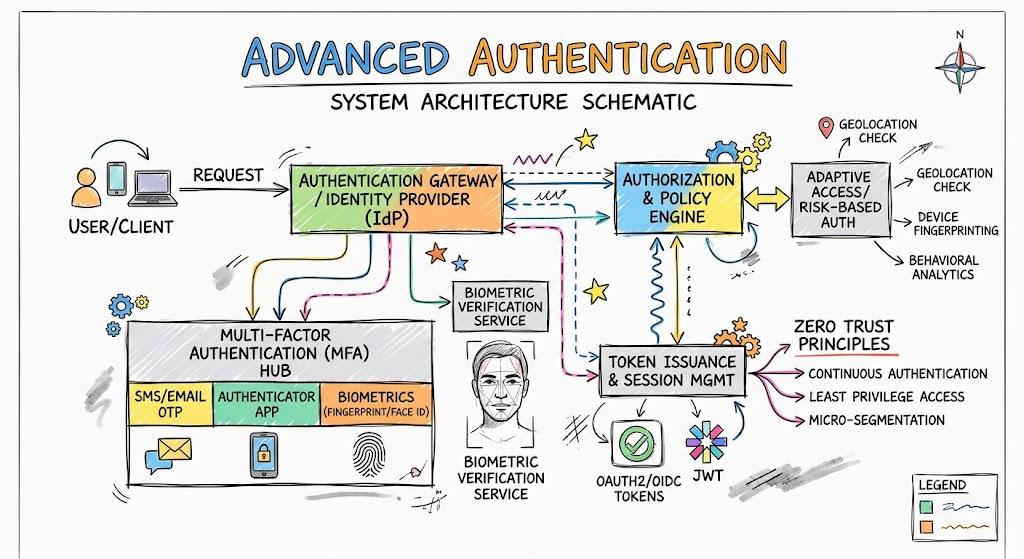
The single most significant and transformative trend in the advanced authentication market is the industry-wide push to eliminate the password entirely. Passwords are the root cause of the vast majority of data breaches; they can be stolen, phished, guessed, or cracked. The "passwordless" movement aims to replace them with authentication methods that are inherently more secure and often more convenient. This trend is being spearheaded by the FIDO (Fast Identity Online) Alliance, a consortium of major technology companies, and the W3C's WebAuthn standard, which is now built into all major web browsers and operating systems. A FIDO-based passwordless login typically involves using a biometric (like your fingerprint or face on your phone or laptop) or a hardware security key to unlock a cryptographic private key that is stored securely on your device. This private key is then used to sign a challenge from the server, proving your identity without any shared secret (like a password) ever being transmitted over the network. This method is virtually immune to phishing and credential stuffing attacks. As more websites and applications adopt this standard, we are rapidly moving towards a future where users will log in to most services with a simple touch or a glance, a trend that is dramatically reshaping the market.
The Rise of Adaptive, Risk-Based Authentication
Another major trend is the move away from static, one-size-fits-all authentication policies and towards a more dynamic, intelligent, and "adaptive" approach. Traditional MFA applies the same level of friction to every login attempt, regardless of the context. Adaptive, or risk-based, authentication uses an AI-powered policy engine to analyze a wide range of contextual signals in real-time to assess the risk of each individual login. These signals include the user's location, the IP address reputation, the time of day, the device's security posture (is it patched and running antivirus?), and the user's normal behavior patterns. Based on this real-time risk score, the system can dynamically adjust the authentication requirements. A user logging in from their corporate laptop on the office network might be granted seamless access, while the same user logging in from an anonymous VPN in a foreign country might be challenged with a high-assurance MFA method or blocked entirely. This trend allows organizations to achieve a higher level of security by focusing friction where it is most needed, while providing a frictionless, "invisible" authentication experience for the vast majority of legitimate, low-risk activities, which is a huge win for user productivity and satisfaction.
Integration with a Zero Trust Security Architecture
The principles of advanced authentication are a foundational and indispensable component of the broader cybersecurity trend known as "Zero Trust." The Zero Trust model rejects the old, castle-and-moat approach to security, which assumed that anything inside the corporate network was trusted. Instead, Zero Trust operates on the principle of "never trust, always verify." It assumes that the network is always hostile and that every single request for access, regardless of where it originates from, must be explicitly verified before being granted. This verification process hinges on strong authentication. In a Zero Trust architecture, a user's identity must be continuously and rigorously authenticated before they are granted access to any application or data resource. The advanced, adaptive authentication platforms are the engines that enable this. They provide the mechanism to verify the user's identity, assess the security posture of their device, and enforce granular, least-privilege access policies for each session. As more organizations adopt a Zero Trust strategy to secure their distributed workforce and hybrid cloud environments, the role of the advanced authentication platform is elevated from being just a login tool to being the central policy enforcement point for the entire enterprise security architecture.
➤ In-Depth Market Studies by Market Research Future:
Catégories
Lire la suite
E-bicycles are revolutionizing personal transportation in the United Kingdom, offering a green, efficient, and health-promoting alternative to traditional vehicles for commuting, fitness, and recreation. United Kingdom e-bicycles are increasingly adopted by consumers seeking to reduce their carbon footprint, avoid traffic congestion, and improve their physical fitness. According to...

The management of chronic kidney disease (CKD), end-stage renal disease (ESRD), and complex renal pathologies requires continuous, multi-disciplinary clinical care, specialized treatment protocols, and rigorous longitudinal data tracking. Within this critical medical software landscape, the Nephrology Electronic Medical Record Software Market plays an indispensable role by delivering...

The landscape of the Blockchain in Security Market is currently undergoing a significant transformation, driven by the rapid adoption of advanced technologies. As organizations across the globe seek to modernize their operational frameworks, this sector stands at the forefront of innovation. The integration of sophisticated artificial intelligence and machine learning algorithms is not...
The Europe Employee Experience Management Market Growth trajectory is intrinsically linked to the permanent shift to hybrid and remote work models and the increasing adoption of data-driven decision-making in human resources. The need to understand and support a distributed workforce, maintain culture, and ensure employee engagement across different locations and working styles is a...
Analyzing the Engine of the 5G Revolution A comprehensive 5G Testing Equipment Market Analysis requires an examination of the highly specialized and technically demanding industry that serves as the quality assurance backbone for the global 5G rollout. This market is not driven by consumer trends but by the complex technical requirements of a new generation of wireless technology and...